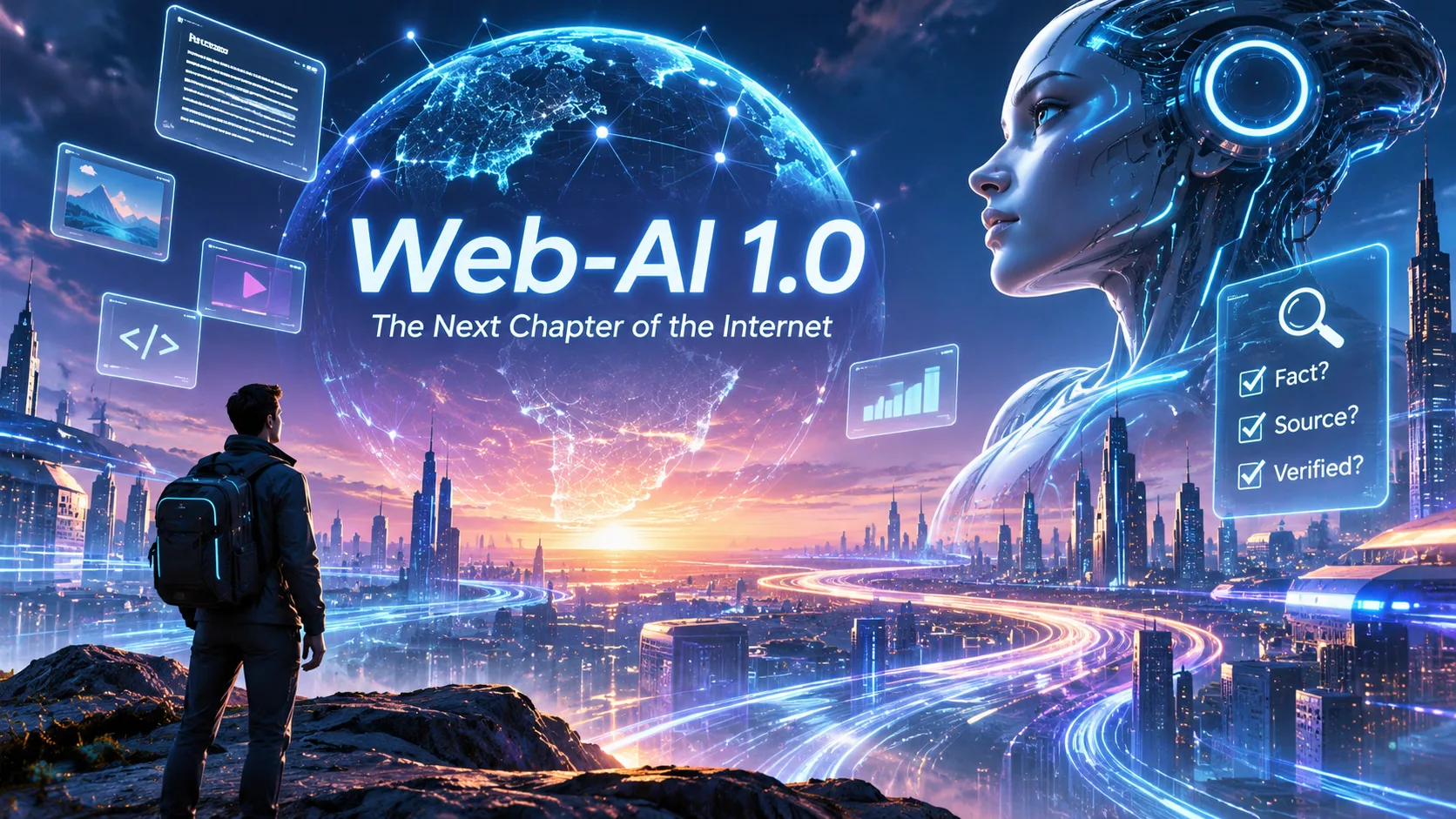
For many years, the internet was a relatively simple place. Websites existed, information was available, and people could communicate across the world. But finding exactly what you were looking for wasn't always easy.
The development of sophisticated search engines, particularly Google and later Bing, helped make the web more accessible. As internet connections became faster and smartphones put the web into people's pockets, the internet truly began to flourish.
We came to know this increasingly interactive, accessible and user-driven era as Web 2.0.
Web 2.0: When Everyone Became a Publisher
One of the greatest achievements of Web 2.0 was making online publishing available to almost everyone.
You no longer needed to be a programmer, own expensive equipment or have a substantial budget to create a website.
Platforms such as WordPress.com and Blogger allowed individuals and small businesses to establish an online presence for very little money, sometimes completely free of charge.
The number of websites grew dramatically. Personal blogs, online shops, discussion forums, news websites and social networks became part of everyday life.
Entire industries developed around this new digital environment. Search engine optimisation, digital advertising, content marketing and social media management created new professions and business opportunities.
The internet became more than a source of information. It became a place where people could work, learn, build businesses, share opinions and connect with others.
But this remarkable freedom came with a problem.
Anyone could publish information, whether it was accurate or not.
As the volume of online content increased, verifying its reliability became increasingly difficult. Opinions were sometimes presented as facts, misleading information spread rapidly, and the distinction between credible sources and questionable claims became less obvious.
Even so, the fundamental principle remained relatively straightforward: people created content, and technology helped other people discover it.
That principle is now changing.
Artificial Intelligence Is Changing the Rules
We are entering another technological revolution, driven by artificial intelligence.
AI tools can now write articles, generate images, develop software, summarise documents and answer complex questions in seconds.
Much of their capability comes from training on enormous collections of information, including material originally published on the internet.
And here is where things become particularly interesting.
Artificial intelligence is learning from human-created information while simultaneously becoming a powerful tool for creating new information.
An individual can now generate dozens of articles in the time it once took to write just one. Businesses can automate substantial parts of their online publishing processes. Entire websites can be created and maintained with relatively little human involvement.
There are obvious advantages.
AI can make knowledge more accessible, help people overcome language barriers, simplify technical tasks and provide useful assistance to those who lack specialist skills.
But there is another side to this transformation, and I believe it deserves considerably more attention.
Welcome to Web-AI 1.0
I would call this emerging stage of the internet Web-AI 1.0.
It is not an official technical classification, nor am I suggesting that the term is already universally accepted. It is simply how I would describe the beginning of a new era in which artificial intelligence becomes deeply involved in both creating and consuming online information.
Web 2.0 gave people the tools to become publishers.
Web-AI 1.0 gives people the ability to publish with the assistance of machines, while those same machines increasingly influence what information we discover and how we understand it.
This is a fundamental change.
The internet is no longer simply a vast collection of information created by humans and organised by algorithms.
It is becoming an environment in which humans and AI systems continuously contribute to the same information ecosystem.
And that raises a rather uncomfortable question.
What happens when artificial intelligence starts learning from information generated by artificial intelligence?
When AI Starts Learning From Itself
Imagine an AI system producing an article containing an incorrect statement.
The article is published online, indexed by search engines and perhaps reproduced or summarised by other websites.
Later, another AI system encounters that information during training or retrieval.
If the original claim cannot be traced back to a reliable source, there is a risk that an error will be repeated, reinforced or presented as established fact.
Now imagine that process occurring millions of times.
Researchers already study related problems, including model collapse, where repeatedly training models on generated data can reduce the quality or diversity of their outputs under certain conditions.
This does not mean that all AI-generated information is unreliable, or that AI systems inevitably deteriorate when they encounter synthetic content.
It does mean that the quality, origin and verification of information are becoming increasingly important.
The challenge is not simply to distinguish between content written by a person and content produced by a machine.
After all, humans can publish false information, while AI can generate perfectly accurate explanations.
The real challenge is determining whether information is trustworthy, supported by evidence and connected to verifiable reality.
That distinction matters far more than the identity of the author.
Can We Still Trust What We Read Online?
For website owners, publishers, search engines and AI developers, this creates a shared responsibility.
We need better ways to identify where information comes from, verify important claims and distinguish original reporting from automated repetition.
Simply labelling content as AI-generated will not solve the problem.
A human-written article can be misleading. An AI-assisted article can be thoroughly researched and factually correct.
What matters is transparency, accountability and the availability of reliable sources.
I believe the next generation of internet tools should help people answer three simple questions:
- Where did this information originally come from?
- What evidence supports it?
- Can I independently verify it?
If artificial intelligence can help us answer those questions more effectively, it could make the internet considerably more useful than it has ever been.
If it merely produces more and more content without improving our ability to evaluate that content, we may find ourselves surrounded by information but increasingly uncertain about what to believe.
Why I Created WebBlog.co.uk
This is precisely why I decided to create WebBlog.co.uk.
I want this website to be a place where we can document, explore and discuss the evolution of the internet as it enters what I am calling the Web-AI 1.0 era.
Not simply to celebrate every new AI tool or criticise every technological development, but to understand what these changes actually mean for ordinary internet users, website owners, developers and businesses.
How will search engines evolve?
Will independent websites and personal blogs remain relevant?
Can small publishers compete in an environment increasingly dominated by automated content?
Will artificial intelligence make reliable information easier to find, or will it make misinformation even harder to recognise?
And perhaps most importantly, will the internet continue to serve the people who created and developed it, or will its future be shaped primarily by the systems that increasingly control how information is produced and discovered?
These are questions worth asking, and I hope this blog will become a place for thoughtful discussion rather than easy answers.
The Internet's Next Chapter Is Still Being Written
I don't believe artificial intelligence is necessarily a threat to the internet.
On the contrary, it has enormous potential to make the web more accessible, productive and genuinely useful.
But technological progress does not automatically guarantee better information.
The success of Web-AI 1.0 may depend less on how much content AI can generate and more on how effectively we can preserve trust, originality and the connection between information and reality.
We have spent decades making it easier for people to publish and access information.
Perhaps the next great challenge is making it easier for people to know what they can trust.
And that brings me to the question I would like to leave with you:
Do you think artificial intelligence will make the internet a more useful and trustworthy place, giving people better tools to distinguish fact from fiction? Or are we heading towards a web where telling the difference becomes increasingly difficult?
I'd genuinely like to hear your thoughts.
Welcome to WebBlog.co.uk. Let's explore the next chapter of the internet together.
Comments (0)
There are no approved comments yet.